Vogue.com
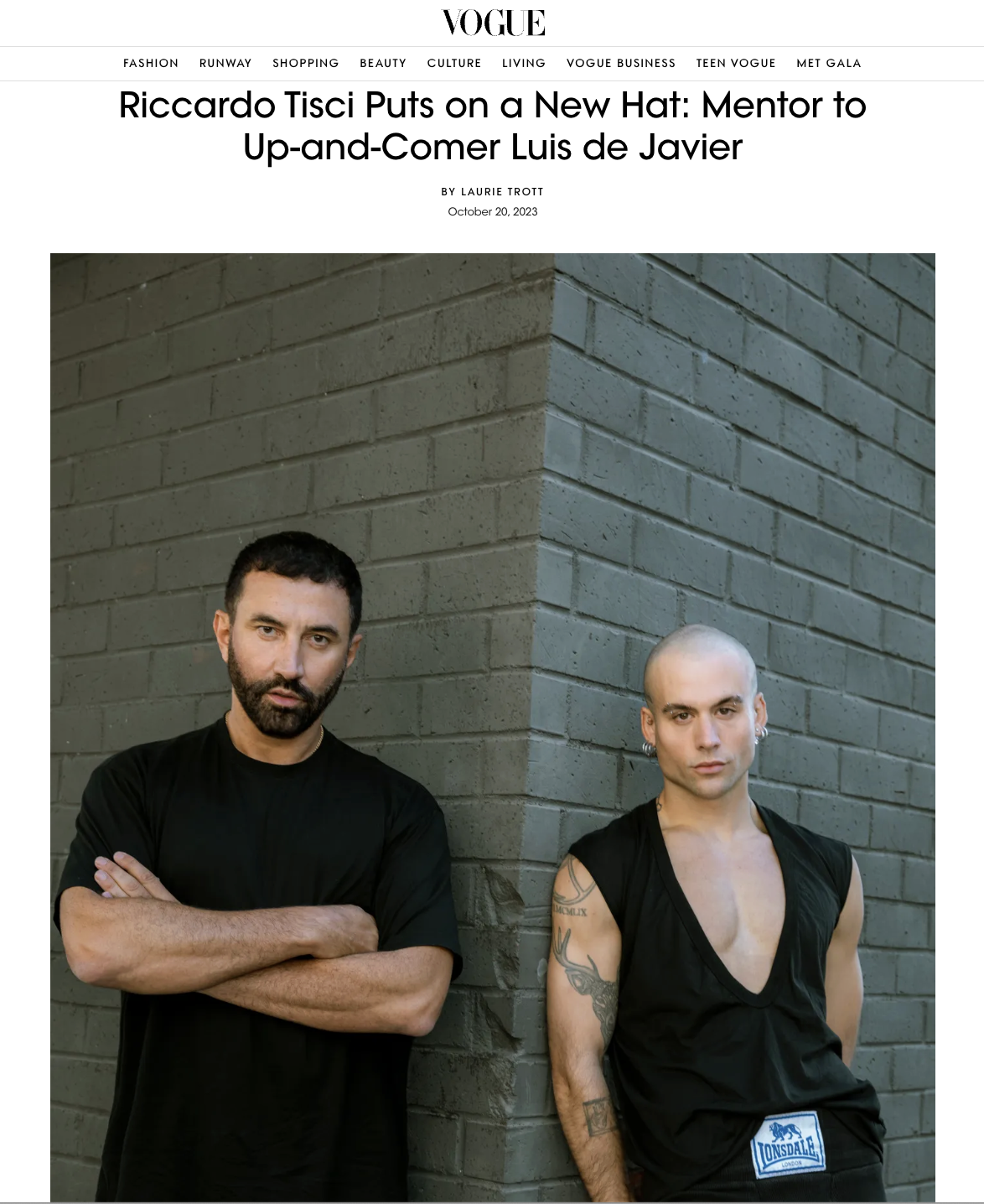
Some of the most fashionable aspects of LA Fashion Week are coming in from out of town. On Saturday, the London-based emerging designer Luis de Javier will present his third-ever collection and he’s doing it in a Hollywood venue. The lineup, comprising approximately 25 looks, has been hand-carried in suitcases by his team, his family members, and his mentor-slash-stylist Riccardo Tisci.
So, how does one get an industry insider as accomplished as Tisci, former creative director of Burberry and Givenchy to style your fashion show?
The two met a few years ago at a dinner celebrating Steven Klein’s photography exhibition in London. “It's very funny,” Tisci recalls. “The dinner was very small, like 10 people. Luis was there, and he was staring at me. And I’m very shy, and he’s very shy as well. And then at one point, he sat next to me and said, ‘You know, it was my dream to meet you’.” De Javier has design experience at Vivienne Westwood and Gareth Pugh. After that conversation he showed Tisci his designs. “I saw his work and it was very strong. And I could see where he was going,” Tisci says. “I don’t get impressed so much about people’s work. But when I get impressed, I get obsessed.” The serendipitous meeting was even more impactful for de Javier. “Riccardo told me, ‘Twenty years ago, it only took one person to believe in me. And I think I’m going to be that person for you.’”
The designers are both Central Saint Martins alums. Over time, social circles overlapped and they would run into each other, which led to a friendship. The pivotal mentorship moment happened early in 2023 when de Javier was working on his show in New York and Tisci was on holiday in Africa. The back and forth of texts—“what do you think of this, what do you think of that?”—was effortless and constant.
Their collaborative process has been very open, but Tisci makes it clear that de Javier is the creator. “You know, I wouldn't tell him what to do design-wise, because I respect him.” He adds, “It’s his design, it’s his collection, it’s his name. I won’t go to the show because the light will shine on him.”
Though Tisci is Gen X and de Javier Gen Z, they share similar cultural backgrounds, are share, among other things, a Gothic sensibility and a belief in championing Queer culture and diversity through design. Tisci calls to mind precise tailoring, romantic flourishes, and liquid leather; de Javier is building a reputation with latex sportswear and sculptural corsets. Both reference their design heroes: Tisci counts Helmut Lang, Azzedine Alaia, and Yohji Yamamoto among them while de Javier ticks off Alexander McQueen, Hood by Air, and Tisci himself.
Tisci recognizes challenges the new generation of fashion designers face. Pre-internet, things happened more slowly and “Now,” he says, “they are either having very fast success or they have a very strong identity but they are so scared to express themselves. They want to make fast business. The hit bag, the hit shoe, the hit jumper.” He references the story of David and Goliath, continuing, “I think this massive machine is going to go back to pure talent and pure creativity. People want creativity and serenity, and I think that the young generation can bring this. It’s not happening right now, but it’s the future.”
Tisci is helping de Javier balance commercial viability and creative integrity. “I need to understand my designs are not only for me and my community. Everyone needs to have a piece of it. And I need to be able to cater to this,” de Javier says. “So what can I do and how can I push myself in order to get there?” His decision to show in Los Angeles was less about the palm trees and sunshine than it was the sponsorship that gave him the chance to do it with his family and team. “Right now I’m in a moment where I just need to go with whatever, to seize any opportunity,” he says. “I can see it and make it into something that works for me and create a whole magical moment that I believe aligns with my story and what I want to bring to the table.”
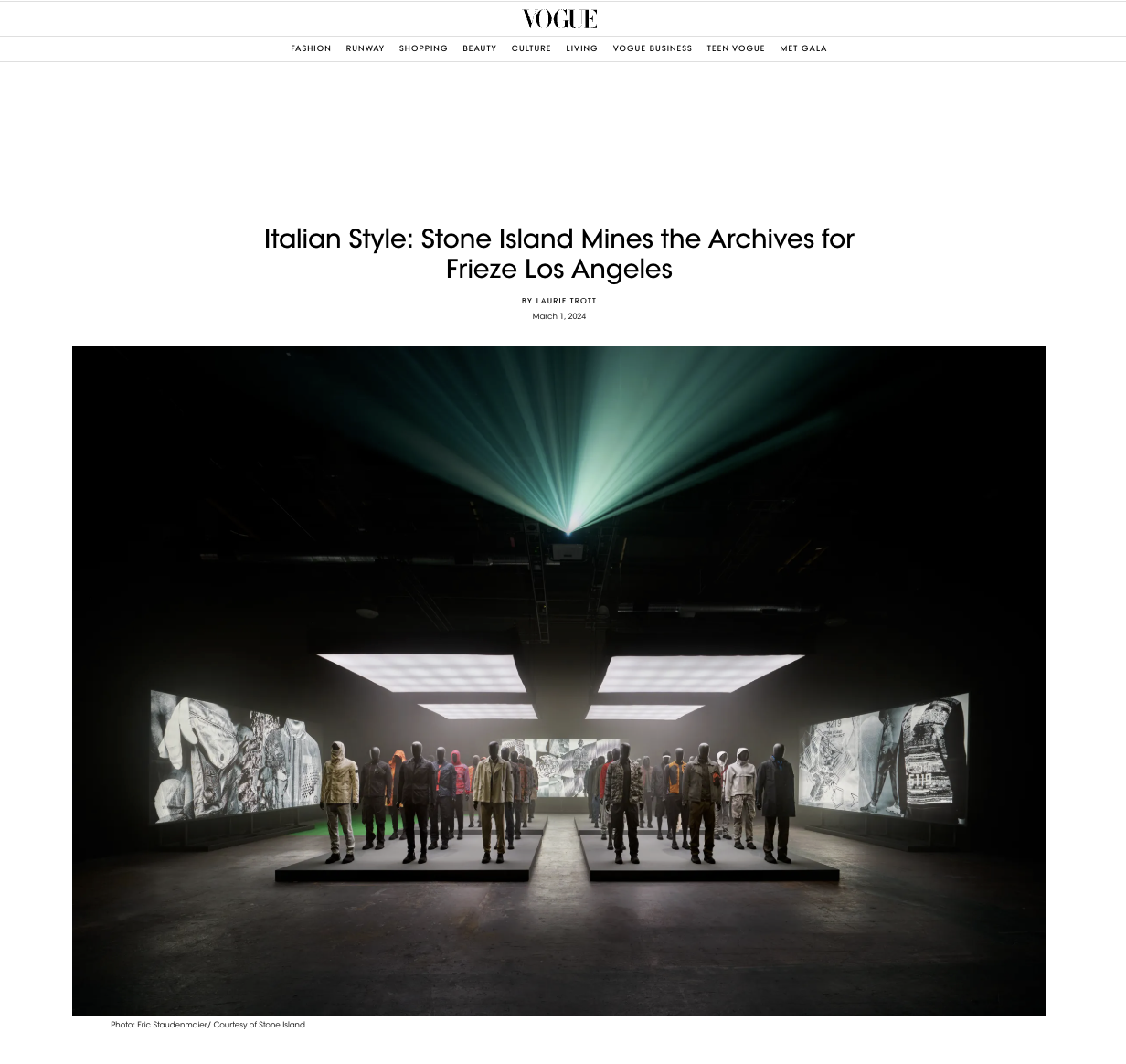
It’s the weekend before Oscar weekend, and the art world has descended upon Los Angeles for Frieze Art Fair. And, with art fairs, as we well know by now, come fashion attachments. Italian outerwear brand Stone Island has a long history of collaborating with artists and recently signed on as an official partner of Frieze, specifically supporting Focus, the section within the fair dedicated to showcasing younger galleries.They’re taking the opportunity to expand their extremely loyal fan base with the LA exhibit Selected Works ’982-’024. It’s the brand’s first-ever US archival exhibition, showcasing rare and never-seen-before pieces.
People seem to either know everything about Stone Island or close to nothing at all. For the latter, here’s a quick primer. You may have seen it on Dua Lipa and Drake, or, if you’re deeply committed to the ’90s, Liam Gallagher of Oasis. Director Spike Lee and Jony Ive are fans. Calling it streetwear is a misnomer. What sets this cult favorite apart from others is dedication to innovation with fabrics and textiles, unique garment dyeing techniques, and the true functionality of each piece.
Fashion houses have been attaching themselves to art fairs for a while, and, when executed poorly, the combination can appear disjointed and confusing. This one makes sense. Consider the exhibition a masterclass in all things Stone Island, and a fun one at that. It’s also really more of an experiential mini-museum than a one-room show. Spaces throughout Buttercup Studios in Culver City are reimagined as galleries featuring different collections, photo installations, and video rooms. Guests can walk through an array of 42 archival pieces—one item to represent each year the company has been in existence, reach inside a clear glass refrigerator and squeeze an Ice jacket to watch it change color from their body heat, and pet the faux-fur parka and other limited-edition pieces from collaborations with Supreme and NikeLab.
The brand believes in ‘Lab-Life,’ meaning building community through production, which opens the door to bring friends of the house, and friends of friends of the house into the fold. Local cafe Community Goods has a setup for a caffeine boost, and Avi Gold’s Better Gift Shop offers a curated selection of vinyl records, rare books, and vintage Stone Island clothing. Throughout the run of the show, there will be DJ sets, documentary screenings, and a talk hosted by Chris Black of How Long Gone fame.
Community doesn’t hold much weight unless it’s formed organically, and there’s a reason that 42 years in, the global underground network of Stoney enthusiasts is stronger than ever, silently communicating with each other through the embroidered wind rose compass badge. So what is it about Stone Island that resonates? According to Avi Gold, it’s the authenticity of the brand. “‘It’s not trying to be anything that it’s not. It’s more than fashion. It’s a lifestyle. It’s vibes.’”